
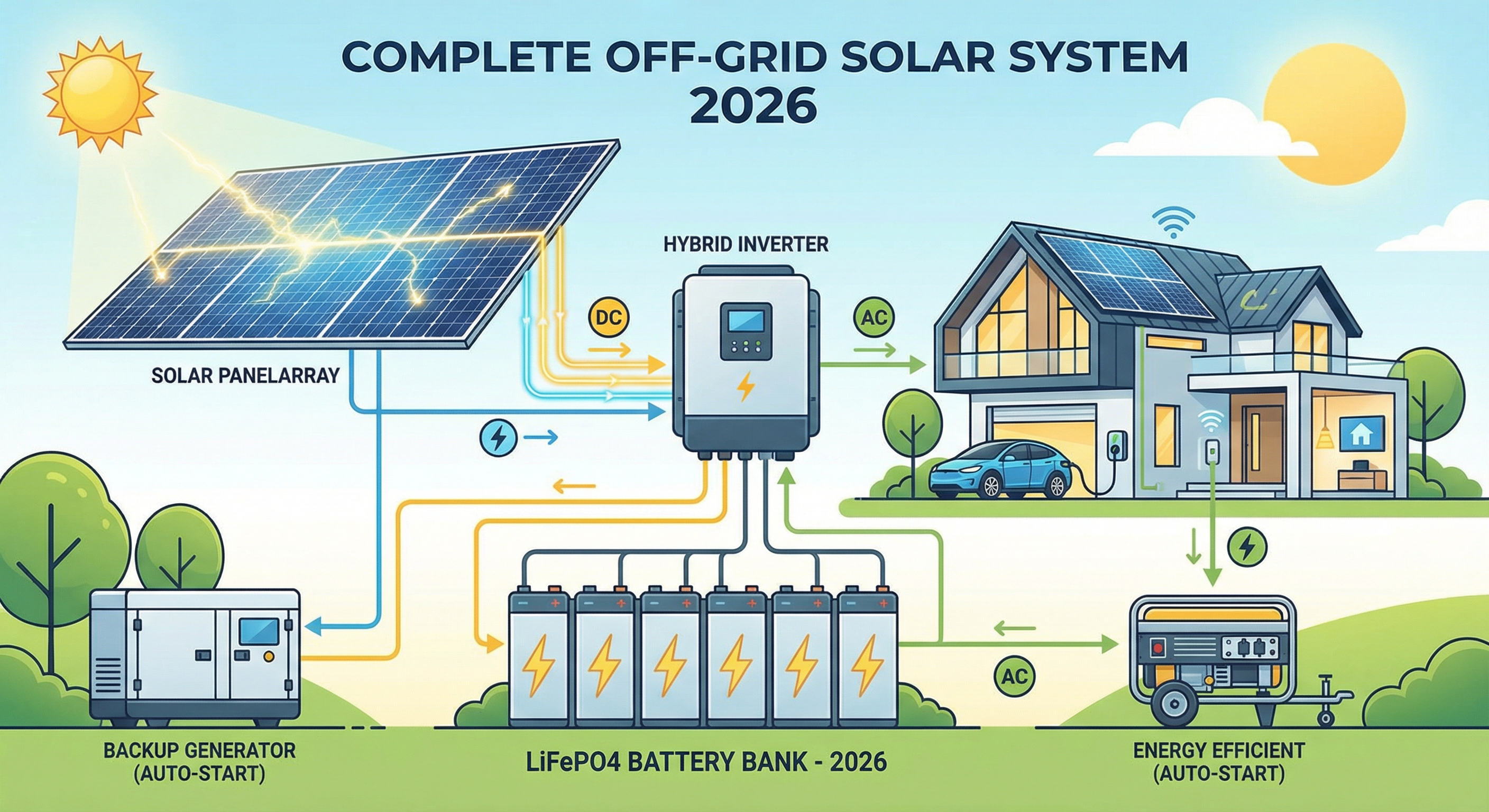
Living off the grid has never been more accessible or more reliable than it is in 2026. With advancements in battery technology, more efficient solar panels, and smarter inverters, generating your own power is no longer just for remote cabins—it's a viable lifestyle choice for anyone seeking energy independence.
This comprehensive guide will walk you through everything you need to know to design, size, and install a robust off-grid solar system. Whether you're powering a tiny home, a remote workshop, or a full-sized family residence, the principles remain the same.
What is an Off-Grid Solar System?
An off-grid solar system is a standalone power generation unit that is not connected to the public utility grid. It relies entirely on solar panels to generate electricity and batteries to store that energy for use when the sun isn't shining.
Unlike grid-tied systems, which can draw power from the utility company when solar production is low, an off-grid system must be self-sufficient. This means careful planning and sizing are critical to ensure you never run out of power.
Key Components of an Off-Grid System
- Solar Panels: Capture sunlight and convert it into DC (Direct Current) electricity.
- Charge Controller: Regulates the voltage and current from the panels to the batteries, preventing overcharging.
- Battery Bank: Stores the electrical energy for use at night or during cloudy days.
- Inverter: Converts the DC electricity stored in the batteries into AC (Alternating Current) electricity, which is what most household appliances use.
- Balance of System (BOS): Includes wiring, fuses, breakers, mounting hardware, and monitoring equipment.
Step 1: Assessing Your Energy Needs
Before you buy a single solar panel, you must know how much energy you use. This is the most critical step in designing an off-grid system.
Calculate Your Daily Watt-Hours
To size your system correctly, you need to calculate your total daily energy consumption in Watt-hours (Wh).
- List every appliance you plan to use (lights, fridge, laptop, TV, etc.).
- Find the wattage of each appliance (usually on a sticker on the back or bottom).
- Estimate the hours per day each appliance will run.
- Multiply Watts x Hours to get daily Watt-hours for each item.
- Sum the total to get your daily energy requirement.
Example:
- 5 LED Lights (10W each) x 5 hours = 250 Wh
- Refrigerator (150W average) x 24 hours (duty cycle ~30%) = 1080 Wh
- Laptop (60W) x 4 hours = 240 Wh
- Total Daily Load = 1570 Wh
For a more detailed walkthrough, check out our guide on How to Calculate Your Energy Consumption for Off-Grid Living.
Step 2: Sizing the Battery Bank
Your battery bank needs to be large enough to power your home through the night and during cloudy periods (days of autonomy).
Days of Autonomy
"Days of autonomy" refers to the number of days your system can provide power without any solar input. For most off-grid systems, 2-3 days is a standard recommendation.
Battery Chemistry: Lead Acid vs. Lithium
In 2026, Lithium Iron Phosphate (LiFePO4) is the gold standard for off-grid solar.
- Lead Acid (AGM/Gel): Cheaper upfront but has a shorter lifespan (3-5 years) and can only be discharged to 50%.
- LiFePO4: Higher upfront cost but lasts 10-15+ years, can be discharged to 80-90%, and is much lighter.
Calculation: If your daily load is 1570 Wh and you want 2 days of autonomy: 1570 Wh x 2 = 3140 Wh of usable capacity needed.
If using LiFePO4 (80% depth of discharge): 3140 Wh / 0.8 = 3925 Wh total battery capacity required.
For a deeper dive, read our comparison of Best Batteries for Off-Grid Solar.
Step 3: Sizing the Solar Array
Your solar panels must generate enough power to:
- Cover your daily energy consumption.
- Recharge the battery bank after a cloudy period.
Peak Sun Hours
Solar panel output depends on "peak sun hours"—the number of hours per day the sun is strong enough to generate peak power. This varies by location. In many parts of the US, 4-5 peak sun hours is a safe average for calculation.
Calculation: Daily Load: 1570 Wh To account for system inefficiencies (wiring, inverter, charge controller), divide by 0.75 (75% efficiency). 1570 Wh / 0.75 = ~2100 Wh needed from panels daily.
If you get 4 peak sun hours: 2100 Wh / 4 hours = 525 Watts of solar panels.
To be safe and allow for faster recharging, you might round up to 600W or 800W.
Learn more about panel types in Solar Panel Efficiency in 2026: Mono vs Poly vs Thin Film.
Step 4: Selecting the Charge Controller
The charge controller protects your batteries. There are two main types:
- PWM (Pulse Width Modulation): Cheaper, less efficient. Good for small systems.
- MPPT (Maximum Power Point Tracking): More expensive, up to 30% more efficient. Essential for larger systems and colder climates.
You size the controller based on the voltage of your battery bank and the total current (Amps) of your solar array.
Read our MPPT vs PWM Charge Controller Guide for specific sizing instructions.
Step 5: Choosing an Inverter
The inverter converts DC battery power to AC power for your outlets.
- Pure Sine Wave: Produces clean electricity identical to the grid. Necessary for sensitive electronics, motors, and audio equipment.
- Modified Sine Wave: Cheaper, "blocky" wave. Can damage some appliances and cause motors to run hot. Avoid for most home systems.
Size the inverter based on your peak load (the maximum watts you will use at once). If you run a microwave (1500W) and a fridge (starting surge 1200W) simultaneously, you need an inverter that can handle at least 3000W continuous.
See Pure Sine Wave vs Modified Sine Wave Inverters for more details.
Installation & Safety
Installing an off-grid system involves working with dangerous voltages.
- Wiring: Use properly sized cables to prevent voltage drop and fire hazards.
- Fusing: Every positive wire connected to the battery or charge controller should be fused.
- Grounding: Ground your system to protect against lightning and electrical faults. See Grounding Your Off-Grid Solar System.
Maintenance
Off-grid systems are not "set it and forget it."
- Clean panels regularly.
- Check connections for corrosion.
- Monitor battery health.
Download our Off-Grid Solar Maintenance Checklist to keep your system running for decades.
Conclusion
Building an off-grid solar system is a rewarding journey towards self-reliance. By carefully assessing your needs, choosing quality components, and following safety standards, you can create a power system that serves you reliably for years to come.
Ready to start building? Check out our guide on Cost of Off-Grid Solar in 2026 to plan your budget.


