
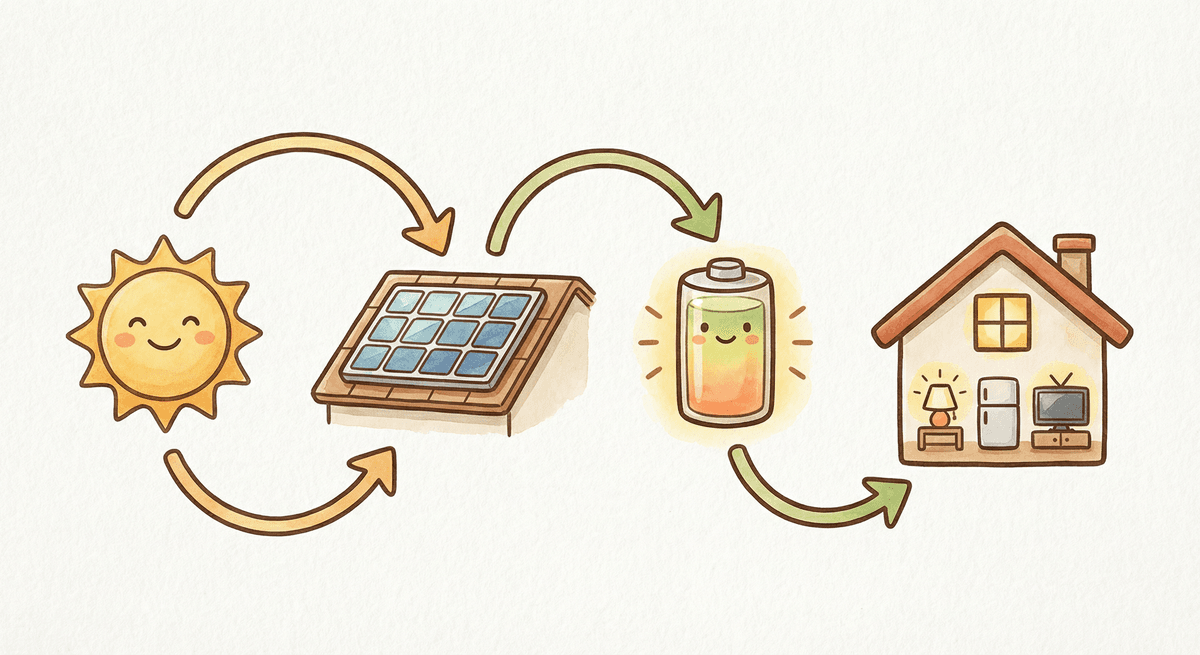
Planning your first off-grid solar system can feel overwhelming. This guide walks you through the main steps: what you use, how much sun you get, and how big your panels and battery should be. No prior experience required.
Step 1: What Do You Want to Power?
List every appliance you’ll run from the system. For each, get watts (from label or plug meter) and hours per day it runs. Multiply: Watts × Hours = Wh per day. Add them up → that’s your daily energy use. See how to calculate daily energy use and load list guide. Add ~10% if you use an inverter (AC loads).
Step 2: How Much Sun Do You Get?
Peak sun hours = equivalent full-sun hours per day at your location. Use a conservative value (e.g. worst month) so the system works year-round. See peak sun hours explained. Look up your area online or in solar maps.
Step 3: Size the Solar Array
Array (W) = Daily use (Wh) ÷ Peak sun hours ÷ Efficiency
Use 0.75 for efficiency (losses). Round up. That’s the total panel wattage you need. See how many solar panels for off-grid.
Step 4: Size the Battery
Usable capacity (Wh) = Daily use (Wh) × Days of autonomy
Battery capacity (Wh) = Usable ÷ DoD
Choose days of autonomy (1–5 typical) and DoD (e.g. 80% LiFePO4, 50% lead-acid). See how many batteries and days of autonomy. Prefer LiFePO4 for new systems.
Step 5: Inverter and Charge Controller
- Inverter: Size for the sum of AC loads (running watts) and the largest motor surge. Pure sine for sensitive electronics.
- Charge controller: MPPT sizing: array current = Array W ÷ battery voltage; add margin. Prefer MPPT for anything beyond a single panel. See MPPT vs PWM.
Step 6: Use a Calculator
Enter your numbers into the WattSizing calculator: daily use (or load list), peak sun hours, system voltage (12V/24V/48V), battery chemistry, days of autonomy. You get recommended array, battery, inverter, and MPPT. Compare with your hand math and adjust. See our calculator guide.
Summary
List loads → daily Wh. Get peak sun hours. Size panels (daily Wh ÷ sun hours ÷ 0.75). Size battery (daily Wh × days ÷ DoD). Size inverter and MPPT. Double-check with WattSizing. You’re ready to plan your first off-grid system.


