
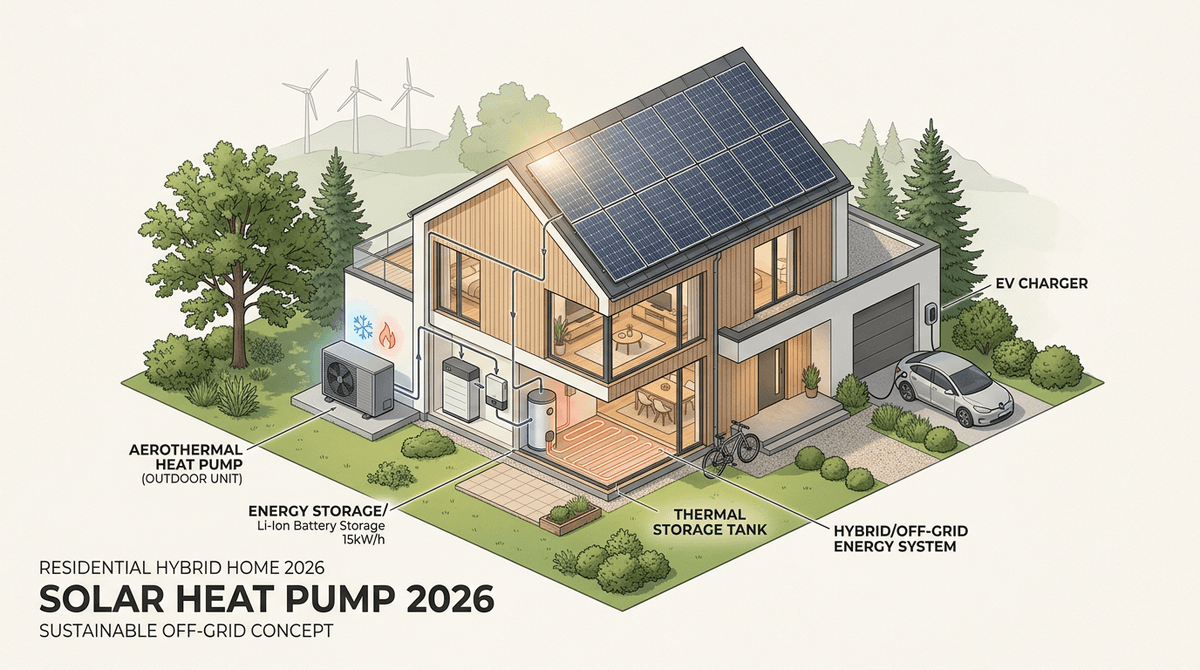
Heat pumps are efficient for both heating and cooling, but they use electricity—often a lot when it’s cold. Running them on solar (off-grid or hybrid) in 2026 is possible if you size the array and battery for the heating/cooling load. This guide covers how much energy heat pumps need and how to plan off-grid and hybrid systems.
For sizing basics, use daily energy use, peak sun hours, and our calculator. For system types, see grid-tied vs hybrid vs off-grid.
Why Heat Pumps and Solar Fit Together
- Efficiency: Heat pumps move heat instead of creating it; they can deliver 2–4× the heat energy per kWh of electricity vs resistance heat. That reduces the solar and battery size needed compared to baseboard or furnaces with electric heat.
- One system for heating and cooling: Same unit for AC in summer and heat in winter; one load to size for.
- Off-grid and hybrid: With enough panels and battery, you can run a mini-split or central heat pump off solar + battery; with grid, solar can offset a large share of heating/cooling use.
The challenge is winter: short days, low sun, and high heating demand. Sizing must use worst-month sun and heating load, or you add a generator or grid for the coldest stretches. See winter and low-sun sizing and peak sun hours.
How Much Energy Does a Heat Pump Use?
Mini-split (single zone): Often 300–1,200 W running when heating or cooling; runtime depends on outdoor temp and setpoint. In cold weather, COP drops and runtime goes up. Rough daily range: 2–15 kWh per day depending on climate and size of space.
Central ducted heat pump: 2,000–6,000+ W running; 10–40+ kWh/day in cold or hot months for a full house.
Example: 800 W mini-split, 8 h/day heating = 6,400 Wh/day (6.4 kWh). That’s a large load for off-grid. Panel need in 3 peak sun hours: 6,400 ÷ 3 ÷ 0.75 ≈ 2,850 W (e.g. 7–8 × 400 W panels) for the heat pump alone, plus battery for night and cloudy days. See how many panels to run appliances and running AC off-grid.
Sizing Solar for Heat Pump (Off-Grid or Hybrid)
Step 1 – Heating/cooling load: Estimate or measure daily kWh for the heat pump in the season you care about (e.g. winter heating). Use nameplate or specs plus runtime, or a load calculator. Add this to your other daily energy use.
Step 2 – Peak sun hours: Use worst month (e.g. December) for winter heating so the system works when it’s coldest and sun is lowest. See peak sun hours and winter low-sun sizing.
Step 3 – Panel size: Panel W ≈ (Daily Wh ÷ peak sun hours) ÷ 0.75. Round up. Example: 8,000 Wh/day heating, 2.5 sun hours → 8,000 ÷ 2.5 ÷ 0.75 ≈ 4,270 W (e.g. 11 × 400 W). Use our calculator with heat pump included in daily use.
Step 4 – Battery: You need enough usable capacity to run the heat pump at night and through 1–2 cloudy days. Usable Wh = daily Wh × days of autonomy. Then Battery Wh = Usable ÷ DoD (e.g. 0.8 for LiFePO4). See how many batteries and days of autonomy. For winter, 2–3 days autonomy is common.
Step 5 – Inverter: Heat pumps have compressor surge. Inverter continuous and surge ratings must exceed running and startup watts. See inverter sizing and running AC off-grid.
Off-Grid vs Hybrid for Heat Pumps
Off-grid: All heating/cooling from solar + battery (and usually a backup generator for long cloudy/cold spells). Size array and battery for worst month or accept generator use. See off-grid cost by system size. This is the most demanding use case.
Hybrid (grid + solar + battery): Grid backs up when solar and battery aren’t enough. You can size solar/battery for a target (e.g. 70% of heating from solar) and use grid the rest. Less array and battery than full off-grid. See hybrid solar systems.
Cold-Climate Notes
- COP drops when it’s cold: Heat pumps need more watts for the same heat at low outdoor temps. Size using cold-season load, not summer.
- Defrost: Heat pumps defrost in heating mode; that adds short bursts of extra load. Inverter and battery must handle it.
- Minimum operating temp: Many air-source heat pumps lose capacity below about -15 to -20 °C; some “cold climate” models go lower. For very cold regions, consider a backup (resistance, wood, or generator) or a ground-source heat pump (higher install cost, more stable performance).
Summary
- Heat pumps are a good match for solar because they’re efficient; the main challenge is winter (high load, low sun).
- Size using worst-month heating/cooling energy and worst-month peak sun hours; add 2–3 days battery autonomy for off-grid. Use our calculator and peak sun hours.
- Off-grid heat pump needs a large array and battery; hybrid reduces size by using grid when solar is low. See off-grid cost by system size and hybrid systems.
Frequently Asked Questions
Can I run a heat pump on solar only (off-grid)?
Yes, if you size the solar array and battery for the heat pump’s daily energy in the worst month (usually winter) and for 1–2 days of autonomy. That often means a large system (e.g. 4–8+ kW panels, 15–30+ kWh battery for a small home with a mini-split). Many off-grid designs include a backup generator for long cold/cloudy periods. See off-grid cost by system size, peak sun hours, and winter sizing.
How many solar panels do I need for a heat pump?
It depends on heat pump size, climate, and peak sun hours. Formula: Panel W ≈ (Daily Wh for heat pump ÷ peak sun hours) ÷ 0.75. Example: 8 kWh/day heating, 2.5 sun hours → about 4,270 W (e.g. 11 × 400 W). Use worst month for heating. Add panels for other loads. Use the WattSizing calculator with heat pump energy in daily use. See how many panels to run appliances and running AC off-grid.
Is a heat pump good for off-grid solar?
Yes. Heat pumps are efficient (high COP), so they use less electricity per unit of heat than resistance heat. That reduces the solar and battery size you need. The downside is winter: high heating load and low sun. Size for worst month and plan for battery autonomy and possibly a generator backup. See days of autonomy and off-grid cost by system size.
What size battery do I need for a solar-powered heat pump?
Usable capacity (Wh) = heat pump daily energy (Wh) × days of autonomy. Example: 8 kWh/day, 2 days → 16 kWh usable. Battery capacity = Usable ÷ DoD (e.g. 16 ÷ 0.8 = 20 kWh for LiFePO4 at 80% DoD). Add capacity for other loads if the same battery backs up the whole house. See how many batteries and best battery chemistry 2026.
Can I use a hybrid system to run a heat pump?
Yes. In a hybrid setup (grid + solar + battery), the heat pump can run from solar and battery when available and from the grid when not. You don’t have to size for 100% solar; you can target a share (e.g. 50–70% from solar) and use grid the rest. That keeps array and battery smaller than full off-grid. See hybrid solar systems and grid-tied vs hybrid vs off-grid.
Size your heating load and system with the WattSizing calculator, peak sun hours, and winter low-sun sizing. For system costs, see off-grid cost by system size and hybrid systems.


